
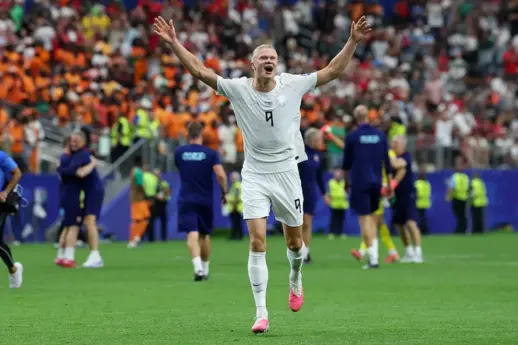
While supporters elsewhere followed a Bangladesh Cricket Match, Erling Haaland stood with his hands on his hips and smiled as the final whistle confirmed Norway’s historic victory. Unlike his jubilant teammates, the scorer of the decisive goal remained remarkably composed. The 2-1 result did more than send Norway past Ivory Coast in the round of 32 at the 2026 World Cup in the United States, Canada and Mexico. It also carried the team affectionately known by Norwegian supporters as the Golden Generation beyond the opening knockout round for the first time in the nation’s history. Haaland, the most influential player on the pitch, delivered the winning goal and several crucial defensive clearances, fulfilling his pre-match promise to give everything for the team.
Haaland had already proved his value as Norway’s leading star during the tournament, but few expected his first major contributions in this knockout match to come inside his own penalty area. On paper, Ivory Coast possessed the superior technical ability, and the early stages confirmed that assessment. Their speed on the flanks repeatedly pushed Norway backwards, producing nine corners during the first half alone and giving the African side clear control of the attacking momentum.
Norway, however, had settled on a practical plan from the opening minute. Their defenders preferred to clear the ball into the stands or concede corners rather than attempt risky challenges against technically gifted opponents inside the box. By making full use of their height, the Norwegians constructed an almost impenetrable aerial barrier.
Haaland was the most visible figure within that defensive wall. As one of the tallest players in the squad, he did not remain near the halfway line waiting for service. Whenever Ivory Coast prepared to take a corner or an attacking free kick, he dropped deep into the six-yard area and took direct responsibility for defending the delivery.
Across nine first-half corners and several dangerous free kicks, Ivory Coast reached the first aerial contact only once. Most of the other threats were headed away by Haaland or his teammates. With Norway’s midfield struggling to progress the ball and Haaland receiving very little possession in attack, the superstar striker never complained. He simply redirected his energy towards defending and helped his team weather the storm.
Ivory Coast coach Emerse Fae had prepared an intelligent tactical plan. Before the match, he said Haaland was a world-class player but stressed that Norway’s collective organisation demanded equal attention. He described the Europeans as disciplined, intense and extremely efficient, warning that they did not require five or six opportunities to score.
His team followed those instructions closely. Ivory Coast pressed aggressively in midfield and assigned players to shadow Norway captain Martin Odegaard, rarely allowing him the time or space to lift his head and deliver passes. The approach effectively cut off Haaland’s attacking supply line. What Ivory Coast failed to anticipate was that a striker deprived of ammunition at one end would become the strongest obstacle in front of Norway’s goal at the other.
A high press can control 99 percent of a match, but one small opening is sometimes all an opponent needs. In the 39th minute, Ivory Coast’s pressure loosened for a split second. Odegaard finally received the ball with space to face the goal and immediately sent an accurate diagonal pass towards the left.
Antonio Nusa moved inside and curled a superb effort into the far corner, giving Norway a 1-0 lead. It was only their second shot on target. In fact, neither team had managed an accurate attempt during the opening 30 minutes. Ivory Coast had undoubtedly been the more proactive side before Norway scored, but once the deadlock was broken, the Scandinavians no longer carried the full burden of defending. Their counterattacks became more decisive, and by half-time they had moved ahead 6-5 in total attempts.
Despite holding the lead, the strain of knockout football remained visible on every Norwegian face. Two first-half misunderstandings saw teammates leave the ball for one another, almost handing Ivory Coast dangerous counterattacking opportunities. Solbakken’s pre-match comments suddenly felt especially relevant. He had acknowledged that Norway were entering the World Cup knockout stage for the first time and said emotional fluctuations were completely natural. His players had prepared for 120 minutes and even a penalty shootout if necessary.
Those awkward moments reflected the inexperience of a team stepping onto this stage for the first time. Haaland’s dependable defensive work became their most reassuring source of stability. With a Bangladesh Cricket Match also holding attention elsewhere, Norway’s players were locked inside a contest where every corner, clearance and misplaced pass could determine whether their historic run continued.
The second half became even more closely contested, and Haaland gradually shifted from defensive worker back into his familiar role as a penalty-area finisher. Trailing on the scoreboard, Ivory Coast increased the intensity of their wing attacks and combined more frequently in tight spaces around Norway’s box.
Ivory Coast finished the match with 14 attempts, including five on target. Although their 47 percent share of possession was slightly below Norway’s 53 percent, much of their attacking danger developed in central areas inside the penalty box. Yet Norway’s compact defensive structure repeatedly prevented the Elephants from turning promising situations into goals.
Norway, by contrast, dropped deeper and relied more heavily on counterattacks and set pieces. They earned only three corners, 11 fewer than Ivory Coast, but every Norwegian delivery created panic around the opposing goal. Their height remained their sharpest weapon at both ends of the pitch, and Haaland was the player capable of causing fear in either penalty area.
Ivory Coast finally equalised in the 74th minute, immediately transforming the atmosphere. The following ten minutes were filled with tension as Norway wasted several counterattacking opportunities and anxiety spread through the team. Then, in the 86th minute, Patrick Berg supplied the decisive pass and Haaland seized his chance inside the box, using an awkward touch to effectively control the ball into the net.
Slow-motion footage made the finish look more like a deflected first touch than a conventional shot. The movement lacked the smooth power usually associated with Haaland. A moment after making contact, he instinctively took another step forward as though preparing to chase the ball, only to watch it roll slowly across the line.
There was no trademark meditation celebration. Haaland simply stretched out his arms and ran towards the corner flag. Only after his teammates surrounded him did the tension finally disappear from his face and give way to a relieved smile.
The slightly clumsy winning goal perfectly summed up his performance. Haaland had spent much of the match embedded in Norway’s defensive structure, using considerable energy and concentration to protect his own penalty area. When attacking possession remained scarce, he accepted the situation without complaint and devoted himself to whatever the team needed. Then, when one decisive opportunity arrived, he made it count. It was not always pretty, but it got the job done.
As a BD Cricket Match continued elsewhere, Solbakken’s pre-match description of Haaland received its clearest possible confirmation. The coach had called him an outstanding leader who set the standard through his actions and always sacrificed everything for the team. From the clinical scorer of the group stage to the player jokingly hailed by supporters as Norway’s best defender in the knockout round, Haaland’s transformation reflected the character of the entire side. Norway did not rely on dazzling possession or overwhelming dominance. Through practical tactics, resilient defending and the complete commitment of their biggest star, the Viking team crossed a barrier that no previous Norwegian side had ever overcome.