
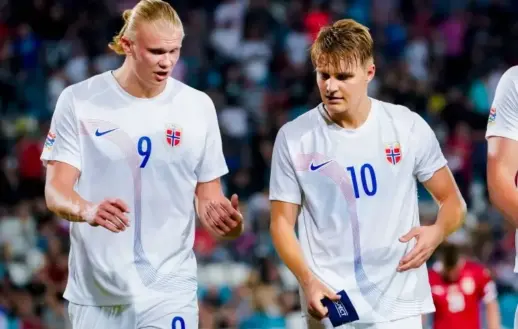
A wave of renewed attention has swept across Nordic football, and Bangladesh Cricket Match fans following global sports stories may find Norway’s recent resurgence especially compelling. For Norway’s squad in this World Cup qualifying cycle, the journey began with a fearless approach. Even though Italy was considered the traditional powerhouse in their group, the Norwegians played with a bold spirit, relying on players like Erling Haaland and Martin Ødegaard to revive the Viking tradition of attacking without hesitation. Their hunger for a return to the global stage was evident from the first whistle.
Through eight qualifying matches, Norway delivered a perfect run. Before facing Italy, they recorded seven straight victories, scoring 33 goals and conceding only four. When the decisive match for first place arrived, they stunned the Italians with a commanding win that left no room for surprise. Their dream of returning to the World Cup after 27 long years finally came true. The numbers tell an even richer story: 37 goals and 29 assists placed them first in Europe’s qualifying zone, while their defensive record of five conceded goals tied for fifth. They ranked top four in several key areas, including chances created and accurate passes. Haaland finished with 16 goals, leading the scoring chart, while Ødegaard’s seven assists topped the rankings. Young winger Nusa added 27 successful dribbles, ranking second on the continent, further proving that this revival was not a one-man show.
Older football fans, especially those who grew up in the 80s or 90s, may recall the era when Nordic teams regularly made their presence felt. Denmark had Laudrup and Tomasson, Sweden had Ljungberg, and Norway had Solskjær. These nations were not global giants, but reaching major tournaments was very achievable. However, after the 2006 World Cup, the rapid development of football in other regions and the gradual decline in Nordic football left countries like Norway falling behind. A lack of emerging youth talent widened the gap, resulting in Norway missing the World Cup for nearly three decades.
Norway hit rock bottom in the 2018 qualifiers, often described locally as the Oslo Shame. Losses to Northern Ireland and Azerbaijan pushed their FIFA ranking down to 88, a level many compared to struggling football nations. This triggered outrage among Norwegian football experts and fans alike. Media outlets openly criticized the state of the sport, warning that Norway risked becoming irrelevant in global football. In response, the Norwegian FA, domestic clubs, and sporting institutions launched a massive rebuilding effort. This is how the Oslo 2020 Project was born, a long-term plan focused on youth development, training systems, and injecting new life into a stagnating football pipeline.
Twelve national-level youth training centers were built or modernized, supported by more than 200 regional grassroots academies. Backed by a structured three-tier system, the project targeted ages six to twelve for early development and U9 to U19 for professional progression. Many retired stars also volunteered, offering professional guidance to the next generation. Information reviewed by the author shows that even smaller regions such as Geiranger, Flåm, and Bodø—home of the now-famous Bodø/Glimt—were included in the plan. The government invested heavily, contributing to a total budget of 120 million euros, alongside support from local organizations and private capital.
UEFA’s solidarity fund later provided crucial assistance as well, especially for smaller clubs like Bodø/Glimt. These funds eased the financial pressure of running youth academies, supporting competitions, and rewarding long-term development. By 2017, after years of experimentation, Norway saw its youth talent pool double, bringing a renewed sense of confidence nationwide. This growth laid the foundation for introducing the ACM model, a tiered academy system designed to categorize and develop talents based on strengths and long-term goals. Each of the twelve development zones focused on specific player profiles, helping young athletes follow tailored paths while still aligning with national objectives.
For example, if one academy had taller and more physical players, coaches would focus on training defenders and target forwards. Meanwhile, regions with fast and agile youngsters emphasized wingers and pace-oriented attackers. Each academy maintained local characteristics but still contributed to a unified national strategy. The results were so effective that countries like Iceland and Finland sent their football officials to Norway to learn from the model.
Norwegian leaders understood, however, that domestic development alone was not enough. To succeed at the highest level, players needed exposure in Europe’s top leagues. Thus, they introduced a talent polishing initiative to help elite prospects secure opportunities abroad. Using a three-step system of data analysis, real-match evaluation, and cross-league collaboration, the program created a reliable and sustainable platform for Norwegian talents to grow beyond their borders. In many ways, this long-term commitment reflects the same determination seen in Bangladesh Cricket Match stories, where patient rebuilding often leads to major breakthroughs. As Norway returns to the World Cup stage after 27 years, their revival stands as a testament to planning, investment, and unwavering belief.